The three pillars of the BRAINCHEF philosophy
We live and function under the rules of a personal representation of reality. Each person carries like a great book where all the laws, concepts, forms, relationships and conclusions of how our reality is structured and how it works are written. We are going to call this our MPR (Mental Paradigm of Reality), our Mental Paradigm of Reality or Belief System.
Everything we know is recorded here, for example that a dog is an animal that walks on all fours and barks, that a bird is something that flies and almost always has feathers, that man works to get things, but that he does not must go to work naked (usually). That if we pretend to be dogs and go out barking on the street, they will probably call us crazy. That if we pretend to be birds and jump off a building, it is unlikely that we will fly. It is written, for example, that if we see something with the face of a dog walking and barking with wings and feathers, something is wrong with our thinking.
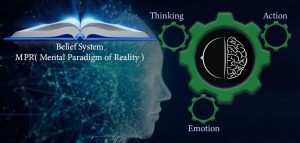
In this great book or mental manual of reality there are many sentences like this:
If I do such a thing, this other thing must happen…
If they do such a thing to me, I must respond like this…
I am this way…
People are normally this other way…
I can do this…
I can’t do this other…
The explanation for this is…
Every day I must…
Many of the laws or explanations that exist in each belief system come from the culture itself or the country where one is born. Then it is nourished by everything that we are discovering, experiencing and learning during life. There is an unstoppable feedback loop between Thought-Action-Emotion, whereby information is added and mixed every second to our MPR. We think about doing something, we do it, we feel in some way about it according to the results of that action. That is saved in the MPR and so the cycle continues without a break.
Our brain is made up of an immense and interconnected network of trillions of neurons, which changes every second. Everything we experience and consume modifies and readjusts that network. From it, our System of Beliefs is built little by little. We are a reactive system, constantly receiving stimuli and responding to them. We never stop seeing, hearing, smelling, feeling and generally receiving information through the senses. So every second that passes we are writing new things in our brain and in turn modeling our MPR.
It is as if our brain were a leafy tree. The wind, the rain and other animals modify its branches and leaves every second. It is never the same over time. Some leaves die and others grow new. Some logs get stronger, others dry up and split. Every little thing that happens makes it different, it never stops changing.

Let’s say that one day you stopped by a flower shop to buy a rose for your partner. Upon arriving at the window, he sees a black rose that seems very beautiful and rare, so he decided to smell it. In your belief system, it was probably written that roses smell good. However, when you smelled it you felt disgust. You were surprised, it’s not what you expected from a rose. You then chose a red one, which you liked very much, and left. Being an unusual situation, he did not forget it, but at the same time he did not give it much importance, because perhaps it was an exception.
Six months have passed, and a street vendor happens to pass near you and is carrying a black rose. You had completely forgotten about the smell situation long ago, but a black rose still seems strange to you, and you try to buy it. When he smells it, unfortunately, the rose smells bad. At this moment something very interesting happens in the brain and that is that a lot of associations arise, such as you begin to think that all black roses smell bad. Although that may not be true, it is the facts that you have faced. It would seem that your brain had forgotten the first incident, but when it repeats itself, it comes to life and generates a whole set of mental organization to try to make sense of what just happened.
What I show with this story is that although it seems that some information does not leave a mark on us, a mark always remains. The proof is that as soon as a similar situation arises, the first one is automatically revived and gains strength to make judgments or form opinions. You can find many examples similar to this. In short, everything we experience is registered in some way in our belief system.
Our BRAINCHEF philosophy acts on the basis of controlling in the best possible way the way that neural network of our brain is fed. In the same way that a chef knows and cooks the best dishes, so it is intended to choose the best information to consume by our mind. That is, we review and choose every day what we see, what we hear, what we taste, what we smell, what we talk to and with whom. This organized selection of what is most convenient for our brain will provide an adequate belief system to achieve our goals.
Our MPR is our main tool to achieve success, or to conquer any company that we propose. Any desire that we want to achieve in our life will depend on our mental configuration or MPR as we have agreed to tell you. We are where we are right now thanks to our thought model and if we want to achieve new goals we must adjust and accommodate it in line with them.

Let’s say, for example, that in your teens you had a partner who broke your heart. That brought with it that he failed several exams, and he did very badly. In those times, a song by The Beatles that marked an era was heard a lot. Every time you listen to it again, it is as if you were reliving those moments of sadness and desolation. Your body reacts to the same stimuli before and responds in the same way, warning you that hard times are approaching where things are going to go wrong. In this case, the chef’s solution is quite obvious, do not listen to the song or the singer anymore. If you have a disk, hide it. If there is anything that reminds you of that, avoid it.
Another example, suppose that in your childhood you had a very dear neighbor who helped you. A wise old man who with each piece of advice inspired him to make good decisions. Thanks to him, she was able to enter the university and graduate with honors. This old man always gave him sweets and his specialty was flan. But he also always used a motto that he repeated, Boy, never give up! That caused him a state of euphoria and motivated him. Unfortunately, your neighbor passed away, but you remember him fondly. In this case, the chef would recommend eating flan, making that phrase something that you often repeat, if you have someone nearby who reminds you of your neighbor, get closer to that person. In other words, these positive sensations are achieved by stimulating the memories that led you on the right path. They will constitute a force to achieve the necessary motivation to achieve their goals.

Im pretty pleased to find this great site. I need to to thank you for ones time for this particularly fantastic read!! I definitely loved every little bit of it and I have you saved as a favorite to see new stuff on your blog.
Itís hard to find educated people on this topic, but you seem like you know what youíre talking about! Thanks
Thanks.